Friday, February 02, 2007

They Are Not Heroes.

Sorry my blog is a day late, but I live in Boston and right now, we are a town under siege.

Now, here’s where I’d like to launch into a carefully crafted absurdity about how the mooninites are a real threat that our bomb squads must meet while burdened in their heaviest kevlar armor, but I can’t quite bring myself to treat the matter with such dignity. However, at the same time, I can’t not write about it—it’s that kind of idiocy.

Beneath all the foolishness there is a genuine threat, and no, I’m not talking about our post-911 culture’s ability to turn a simple prank into a national news item. I’m talking about the incredibly bullshit idiocy of guerrilla marketing in service of international corporations.

Now, I like Aqua Teen Hunger Force, and I praise the folks whop created it and made it shine because they are living the dream: they have taken a thing from their imagination, sold it to the world, and now don’t have to go to a design job, or bartend, or temp, or walk dogs, or any of the terrible, terrible things millions other creative people have to do every day to keep their heads above water because so far, no one wants to pay enough for the things we pull out of our imagination.

But the guys who did this little stunt, who conceived, orchestrated, and executed the ‘put dozens of small glowing moonintes all over the city’ are not praiseworthy. They are tools. They are marketing a product owned by Turner Broadcasting in the hopes of increasing awareness of that product so as to make more money for the stockholders. They are taking their own creativity, their own abilities, and whoring them out in the worst possible way: these selfish, shortsighted idiots are selling out, not just themselves, but the language of the disenfranchised, of the genuine artist, of the person with no other outlet but that which they can carve from the resisting world.

Guerrilla marketing used to be just that— guerrilla. It was an attempt by some penniless, powerless person or group to get the word out. It was a rejection of the standard means of publicity, either due to cost considerations or a rejection of the whole idea that self expression should be regulated or cost money. Also, putting small bits of carefully created crap all over town used to sometimes be called something else- not marketing, but art. That’s right, we used to have a thing called guerrilla art, which wasn’t a way to market a thing, but was the thing itself. It was illegal and dangerous and itself a rejection of galleries or publishing and based in a belief that art should be made, seen and shown in the real world where people actually live.

Peter Tork of the Monkees—that’s right, Peter fuckin’ Tork- once said that ‘The hippy culture will never produce anything of lasting significance because once a movement begins to grow it is co-opted by the system.’ That shabby paycheck-cashing pre-fab Paul McCartney was right on because now the biggest companies on the world are hiring reckless young idiots and training their raw creativity, daring and disrespect for society in ways to make those corporations more money.

Yes, the guys picked up for the gag can give their bullshit press statements and flaunt their oh-so non-conformist dreadlocks but they did this not for an idea or a concept or principle, they did it for a product. They did it for a paycheck. Those two fuckers could have made their statement in the gowns of last year’s Oscar winners for best actress and it wouldn’t change the fact that they are just like everyone else: they get up in the morning and go to work on a thing they didn’t create in the service of powerful men. They are in-harness, and their job is to take the canvas of installation artists, graffiti artists, guerilla artists, and make it palatable for Turner Broadcasting. To use public property to promote a movie made by a company that took in billions last year.

Face it: if it had been Exxon or McDonalds or Haliburton instead of Comedy Central, ‘Hip, young Bostonians’ wouldn’t be laughing about it. They’d be pissed off. But it's clear now that if you hide what you are doing behind a pile of foul-mouthed pixels, it’s okay—your target demographic will give you a pass to shit where real guerrilla artists eat.

As for me, I’ll be pissed whenever I see some odd object that might be some sincere artist’s attempt at injecting some wonder into our lives, to challenge us and make us think about space and use and urban design and whatever else, because I’ll have that doubt that the thing I’m seeing, the out-of-place expression of creativity that has been illegally placed on a landmark or overpass or train station, is just a commercial.

Thanks a lot, fuckers. I hope the city fines your asses into oblivion.

--G

Tuesday, January 30, 2007

Free Book Distribution, Podcasting, And Thou

James Palmer here with another article cum rant about writing.

A couple of things conspired inside my head for today's article. First off, I was listening to Mur Lafferty's I Should Be Writing podcast, where she interviewed a guy named Matthew Wayne Selznick, who self-published his novel Brave Men Run at Lulu.com and did it as podiobook.

Secondly, I read an article in last week's DM News, which I keep up with because I'm a copywriter, about a new plan by Google to offer free online public domain books. Science fiction author Cory Doctorow is mentioned in the article, and explains how he offers free electronic downloads of all of his works, and it doesn't impact sales.

Now, on to my point. I'm still a bit leary over giving away your stuff for free and not going the traditional publishing route, and I think newby authors should be as well. Here's why.

Selznick was telling Mur about how many times his book has been downloaded and how people have left him money in Podiobooks' online tip jar. Doctorow talked about how over 750,000 copies of his books were downloaded, and that these free downloads didn't effect sales of the printed books, and so on and so forth.

But don't you think it's more likely that those 750,000 downloads are more a result of them being for free and easy to snag? Maybe not in Doctorow's case, as the man has a well-established track record for putting out entertaining fiction. But what about all these first-time podiobook authors? How many hundreds of thousands of free-loaders have to download their work before they find the few dozen honest individuals who will actually throw a couple of bucks their way?

Speaking only for myself, I downloaded Doctorow's Down and Out in the Magic Kingdom because I wanted to read it AND it was free. But I never got past chapter four. See, I have other things to do when I'm at the computer, like write my own gibberish. I don't have time to sit and read pages and pages of .pdf text. And there aren't any really good, inexpensive ebook readers yet. At least I listen to podcasts, but only because I have an audio jack in my car where I can listen on the way to the day job.

If there's a bright side to any of this alternative to traditional publishing stuff, it's in giving people other options. Selznick's book existing simultaneously as a printed book, an audio cd, and an .mp3 file will open it up to more than one audience. Even in science fiction, you've got people who will never adapt to .mp3's and the like, so for them, a print book is the only way they will ever know you exist.

Perhaps another bright side is the publishing industry's acceptance of this, allowing authors like Cory Doctorow and Charles Stross to offer their books free of charge before they've even been published, under a Creative Commons license. After all, an industry with huge overhead caused by printing, storing, and distributing books that will go out of print inside a year, and a marketing machine that only promotes your work if you're already selling Stephen King level numbers, it's nice for them to recognize their shortcomings and look at a new way of doing business. Unlike the music industry, who is trying desperately to keep control of a system so vile and corrupt it's what made consumers and musicians look for other alternatives in the first place, the publishing industry is helping these early adopters try something new.

In the end, it's basic niche marketing. Unlike print publishing, which is mass marketing, niche marketing gets your stuff only to the people who are most likely to buy. This is very important, especially in the science fiction field.

But, for myself and any newbie authors wanting to make it, traditional publishing still seems to be the best way to go. I'm all for online books, which would drive the price down and authors would make up the difference in volume, but if we give everything away for free, our work will have no value. The occasional seven bucks from a Paypal tip jar won't allow anyone to keep creating stuff for people to try to rip off.

Saturday, January 27, 2007

The Freakin Process

Hi and welcome to my column. You'll be seeing me on the weekends when I can drop by and add some words to the general pool of wonderfully interesting stuff you're going to read here. During the week you can find me over at my blog, ArsGeek writing my predictions for the future of technology, interesting ways to use operating systems, posting keen links or talking a bit about new rodents that have been discovered. There, that's my first and last plug.

While I don't have much to offer in the way of speculative fiction on that blog, I do spend a lot of time writing for the site. When I'm not writing for that, I enjoy writing for it's own ends. I've been putting words to paper and fingers to keys for a lot of years now with some interesting, horrible and occasionally good things coming out of it.

What is it that makes some of us do this? Is it the same thing that motivates engineers to design computers that can't be opened and are guaranteed to scrape six inches of skin off your knuckles? God I hope not.

On thinking what motivates me to write and how I actually accomplish the writing process, I came to realize a simple truth about myself. For me writing is, most especially when it comes from the soul, a gut wrenching experience which can drain and exhilarate me at the same time. It is comparable to almost wrecking a car, only to pull out of it at the last possible moment while also rescuing a tree bound kitten and saving the neighborhood orphanage from bankruptcy. With some of my projects I never quite reach the kitten/orphanage stage. That is why I enjoy having written much more than I enjoy actually writing.

This is what I call the Freakin Process. The thing which brings me to the heart of writing, whether it's your fifteenth novel or an article on shell scripting. It's something of a universal truth that it takes about five thousand times more effort to write a sentence than it does to read one.

So why do I continue to write, even in my spare time when I could be watching television or doing something else to degrade my mind? The answer is that I really enjoy having written. So much so that in the end the unavoidable struggle with myself and occasionally my computer is all worth the sweat blood and ink I've poured into it. That in itself is inspiration enough to write but when I can create and add to a genre, be it scientific, poetic, non-fiction or fiction; when I can affect one person with my ideas or generate one new thought, that effort becomes a necessity. This is the closest I can come to creating something hitherto unseen on this earth.

That creation process, like sex or Jackson Pollock, can be very messy. Once in a while it can even be inspired.

What's it like for this geek to write? It goes something like this:

I sit at my computer and fire up OpenOffice. I minimize OpenOffice and cruise around Fark and BoingBoing a while. I Pop OpenOffice back up and type a few lines, which I then delete in a frenzy of keystrokes. I grab a coffee. I gaze longingly at my screen and work at convincing myself I'm a creative kind of guy. There's some head scratching going on here and I get a strong desire to call someone I haven't talked to in a while. I try and spell Jackson Pollock without resorting to Google. This is where the struggle begins. I force myself back to the keyboard and begin to type rapidly. Then I stop to make a few adjustments and as inevitably happens the computer does what I tell it to and not what I want it to. I become a very creative kind of guy and make up a whole new category of cursing, often involving sharks, aliens and their improbably love children. I type on, trying to wrest the thoughts from my mind into language that other people will understand. I click about for a good song on my media player. And so the process continues.
All of this you see, is to write a 300 word story on the uses of some basic Linux command. The real creative stuff takes a real effort.

Every once in a while, something will grab my by the short hairs and suddenly after regain a sense of my surroundings I'll look back at three or four pages of really good stuff. My muse, what ever the hell that is, has struck again and I've written not as a struggle but as if that's what I was put here to do. That's the beauty in this whole thing. That's when I look back over my shoulder, cast my face towards the sky and say "where the hell were you two hours ago!"

It's really the past tense that I'm seeking. After all of this has been accomplished, when the smoke clears from my keyboard and my lap is cooling from where I've removed my laptop I can sit back and relax and reflect on having written once again.

Thursday, January 25, 2007

How to Write (or Avoid Writing) Like Stephen King by Lucien Spelman

Caveat:


I love The King. I have read almost all of his work, I am in the middle of Lisey’s Story right now, and I often quote from The Dark Tower books. However… Stephen King has a formula of style. It’s a formula I love, but it is a formula nonetheless, and I have been reading so much of The Master of the Macabre lately, that his stylistic approach has ingrained itself into my psyche, and if I’m not careful it will ingrain itself into my writing as well.

In order to avoid this, I will unfold pages of his blueprint for this blog, and thus, hopefully, recognize and circumvent using his methods in the future by expelling them from my unconsciousness mind.

There are a few elements which one must follow if one wants to write (or avoid writing) like Stephen King:

1: Whenever possible a new section should be started with lyrics from a slightly out of date, and/or slightly obscure Rock Musician or Band.

2: Part of the language of the work must be constructed within the confines of the story being told. In other words, invented words or modified regional colloquialisms must be created and referred to throughout the story in order for the reader to feel as though they are an Insider.

3: The invented words, if possible, should have a back-story of their own relating to one or more of the characters.

4: An internal dialogue must take place within the head of the narrator, protagonist, or antagonist, and the above mentioned created “private” language must be used in said dialogue. If the narrator, protagonist, or antagonist question whether inner dialogue is from a source outside of themselves, so much the better. The internal dialogue should be formatted in italics rather than quotes to avoid confusion.

5: All action should occur in New England. If it does not occur in New England, the narrator, protagonist, or antagonist should at least be on their way to or from New England.

6: Paragraphs should be interrupted with abrupt parenthetical or italicized asides relating to previous action in the story. This gives the reader a feeling of thrilling uneasiness.


With all these elements in place then, my Stephen King style blog for this week should look something like this:


“She did a triple somersault and when she hit the ground, she winked at the audience and then she turned around.

She had a picture of a cowboy tattooed on her spine saying Phoenix, Arizona, nineteen forty-nine.”

- The Coasters, Little Egypt


The last few days have been ball-busters here at BBT Magazine. The next issue is wrapped and at the printer, but we’re staying very, very busy with the new t-shirt line from Christoffer Saar (you should see more this week or so), and the new Chapbooks that Pete Tzee is working on, and it’s been cold here in Massachusetts – cold enough to freeze a witch’s tits my mom would’ve said, God rest her soul.

You got that right, mom.

You got that right.

Besides the cold though, things have been good, just busy.

POW! BAM!

We’ve aimed ourselves at the New York ComicCon this Feb, and we intend to interview a few of the guest there for forthcoming issues. We have obtained press passes, and get to arrive a few hours before everyone on Fri, so we have a shot at interviewing and mingling with such luminaries as Stan Lee, Kevin Smith, George R. R. Martin, J. Michael Strazynski, and of course The King himself, Stephen King.

I just hope the cold let’s up.

Cold enough to freeze a witch’s tits.

Thanks mom.


Until next time,

POW! BAM!

- Lucien

Friday, January 19, 2007

I Understand The Need For Airport Security, But Really! by Earl B Morris

I am writing my blog this time around a little late, because until 4:30 this morning I was held in a correctional facility outside Atlanta, Ga. It’s a long story, and I’m exhausted, but I will briefly go over the situation for those of my fans that are curious, and for my great aunt, who is a regular reader of our columns here at BBT: The Blog.

I was on my way to Williamsburg, Virginia to attend the annual Marscon, a Science Fiction & Fantasy convention that is now in it’s 17th year. I was to be a surprise guest Filker there. Nobody booked me, but my jazz harp teacher suggested I dress up as my favorite hero and surprise the staff with a few songs. At least that’s what I think she said, she has a very thick German accent & a slight harelip so sometimes communication is rather difficult. (We were once almost to the point of fisticuffs when I mistook her kind offer for a scone as an insult to my little Cairn terrier.) For those of you that are out of the loop, and unaware of what filk is – think folk music sung by Ray Bradbury or J.R.R. Tolkien.

I prepared the night before the flight by fasting and meditation, and preparing a wonderful set-list, which began with my rather well known ballad “Do Androids Dream Of Electric Me?” The following morning I donned my costume and lit off for the airport, excited at the prospect of getting my filk on as it were. I was dressed as my favorite Argentine super hero – Supervolador. (I have always preferred to fly in costume as the spandex is wonderfully comfortable, and it’s a great conversation starter.) I arrived at the airport and was a few minutes early for my flight, so I loosened up with a few drinks at the local sports bar. (I’m not a big sports fan, but I met a delightful fellow who said the Dodgers and the Rams may possibly meet one another at Wimbledon this year or something, but only if Tyson or someone gets to play goalie. So if you’re a “Sporty” you may want to keep your eyes peeled for that game.) I heard my flight being announced over the P.A, so I headed at a breakneck pace down the terminal announcing (probably rather rudely) that I had a plane to catch. I made my way to the security checkpoint and was told I would have to remove my mask and take off my shoes. I told the security guard, a rather large angry looking woman, that I would be happy to remove the mask (as long as she didn’t reveal my identity, I joked), but I could not remove my shoes without taking off my pants, as the boots were integrated into the spandex leggings. She demanded I did so, and began waving a metal wand in my “quiet areas”. I asked her to stop, and becoming rather annoyed I said, “Listen mama! Do you think I have a bomb there?” She must have been very offended by my rather (admittedly) sexist referencing of her as “Mama”, because no sooner had the words escaped my mouth, than twelve large fellows escorted me to a distant office. When I noticed they were man-handling my harp, I became rather agitated again, and that did not seem to help matters much.

I have to return to court on the 23 of Feb.

Needless to say, I missed my filking show.

Wednesday, January 17, 2007

You're a star, baby.

"Ye gods," you think, "Is this man never going to return to the subject of writing, which is the thing he does and therefore has a reason to blither about? Shall we forever be getting his opinions on other things, things which lots of people have opinions on."

I may return to writing. I bet I will. But I won't say for sure, because it is the mystery that lingers, and not the suspense.

Today, we talk about....American Idol. AND Writing! HAH!

No, come back, seriously, listen to me for a minute. I'll buy you a drink afterward.

These past couple of years, I've been watching American Idol with something like fanatical obsession, something which I don't admit in public very often and am slightly ashamed of. (Probably the only person more publicly ashamed is He Who Watches American Idol in Women's Clothing.)

The start of this season (yesterday) was hotly anticipated here in the Tzinski household, probably in particular by the male member of the Tzinski family, who is typing this blog entry right now. So we settle in, we wait for the DVR cable box to get up to speed, which took less than an hour tonight! and we watch the Minneapolis auditions.

First, I apologize. Out of 10,000 people, we Minnesotans produced seventeen. The rest were abysmal. In my defense, I'm not from Minnesota and in times like this, I don't claim it. (Although after watching Seattle's auditions, I don't even claim Seattle as part of the United States.)

As I watched in enjoyment and occasional horror, though, the one thought that bubbled up in my mind and wouldn't go away was...My God....those who are getting rejected are just like inexperienced writers!

It was horrifying beyond the bad singing. I refer to a specific sort of young (generally) and inexperienced (sometimes) writer, who may or may not be sane. Usually has not had their recommended dosage of perspective for that day, too.

They're the writers, the equivalent of those Angst-Ridden crying kids who come out of American Idol crying about how MEAN everyone is, how much everyone HATES them, how much no one GETS them. They're writers like that.

There are loads of them. They are the writers that treat rejection letters like personal attacks against themselves, their families, their camels, their fertility, and their generations to come. They are the writers who assume that, just because Bantam Books has not thus far beaten down their door to buy up their freshly finished manuscript before the blood dries, the publishing industry therefore HATES them and wants them never to get published.

The reason the publishing industry doesn't want them to get published is, generally, a deep conspiracy on all levels to insure that this person, this gifted individual and their ART, their ART man, does not reach the people.

Me and Simon Cowell would like to point out that it's not a conspiracy. Here's the thing. Sometimes, you get a rejection letter because you aimed at a target and missed a little. The market doesn't need exactly what you're offering. Maybe it's not bad. It's like being a rocker who goes on American Idol. With scant few exceptions (where we could argue about how well applied the term rocker was) rocker vocals do not work on American Idol. Likewise, perhaps your slipstream romantic comedy story set in space dystopia does not quite match Ellery Queen Mystery Magazine.

Sometimes, both in singing and writing....what it does mean isn't that it's a conspiracy, it means you can't sing. You can't write. Not everyone can do either. I think that everyone can learn to communicate literately in written form, which is not the same thing as telling a story. I'm not saying you should walk away from either one, not if it's your passion. I'm just saying you can expect rejection, and you shouldn't rant and rave against it.

So how do you know if you're good or bad? Well, you don't really. You never fully do. Look how much angst James Joyce managed on an average of writing...whatever it was that he wrote. (James Joyce: As many made up words as Dr. Suess, or your money back!). Some people write for years and years and are never satisfied with what they finish. Likewise, some people can sing magnificantly and are somehow inherently convinced that they're just, you know, okay, they guess.

I guess I tend to use money as a gauge. If someone pays me for something, then either it's pretty good, or they're pretty drunk, and either way the check cashes, so THAT'S all right.

But mostly, what you do is use perspective. This is for singing and writing (a surprising number of people do both; and I mean prose, not lyrics or poetry). Use your head. Assume for a moment that it is entirely possible you are not the big cheese and the camera's not on you, baby! Even if you are the big cheese and the camera is on you, it's important to think that it's not. Humility is not a bad thing, not even a little bit.

Neither are manners. I remember those. I know they exist, 'cause I done got me loads of 'em when I was growing up, and I still use them today. I hold the door open for people, though it may be inconvenient. I'm polite in my capacity as a writer, because at the same time I'm also in my capacity as a human being. If you're a writer, if you're a musician, a singer, you should be polite. Be nice. So little is gained by being brusque and rude with people.

Perspective is the key to all of it, though. It's where you take a step back and say "Okay, wait, hang on....what AM I doing?"

Remember that all these terrifying people on American Idol during the horrifying auditions, fresh from their runs with the circus and now going to perform...all of them laughed at the creepy guests in previous seasons and said "God, I'm glad I'm not like THEM!"

Perspective is where you entertain the possibility that you're exactly like them, and then try your damn hardest to make yourself better. If you're like them, maybe you will make yourself better. If you were already better, maybe you'll learn something a little new. Doesn't hurt either way.

...

Final thought.

Too many of the singers on things like American Idol talk about being a star. I think that's a pretty piss-poor attitude to go in there with. I think it's also a worrying thing with some young writers.

The singers want to be a star! They want to be divas! They want to shine, they're the star, baby, twinkle twinkle, you're like a musical goddess! Omigod! The writers are the next Dan Brown, the next Stephen King, the next J.K. Rowling, no seriously, they are, if you would just buy their stuff, you don't understand, they're literary gods...!

It's the desire to be topp, without putting in the work to GET topp. It's the desire to be the LEGEND of Johnny Lee Hooker, without the bit where you play in the street and rundown gin joints and teach yourself to read.

It's the part where you're Stephen King, bestselling author-god, not the part where you're a young man sitting in a laundry room with a typewriter on your knees, hoping you can finish this book, scared that you're going to be trying to finish this book and telling people "I'm a writer," in fifty years when everything will feel like it's over.

The work is just as important as the result. For writers: When you make your office, make it simple. That's important, and Steve King said so too.

My office right now is the closet, just inside my front door, where you would otherwise have hung up your coats. I have some action figures on a shelf, I have some blue electric lighting rope around a hanger rack. I have two TV dinner tables as my desk, and a folding chair to sit in. I put my iPod next to me wiht headphones, I put the laptop on the TV dinner table, I shut the door, and I write until I run out of air. Then I take a ten minute break.

This is the work. This is the most important part.

Fortunately, you have perspective, so you already knew that.

...

Okay, final plea to the contestants of American Idol: Please. No more angst. Okay? I can't take it. It's like being locked in a room full of hormonal teenagers who are writing sad poems about how much their dads hate them and why only Kurt Cobaine understood them, except for the bit where he died the year before they were born. No more angst. Have a good attitude, be nice, do your best. If you had problems...you had problems. We all had problems.

YOu want to talk about problems, you go into the blues, baby.

Give John Lee Hooker my best, please.

Thursday, January 11, 2007

How I Spent My Sick Day

Next time you take a sick day, watch Office space and Fight Club (both 1999) back to back like I just did, and you'll see that they are kinda the same movie. In both films, the protagonists are close to cracking beneath the pressure of their god-awful jobs (Edward Norton probably has it a bit better as his soul-deadening insurance company work gets him out of the office at least).

In Fight Club, our hero (Edward Norton) deals with these pressures by forming a splinter personality (Brad Pitt as Tyler Durden) and together they launch some kind of vague proto-terrorist-merry-prankster-bare-knuckle boxing outfit that destroys half of the city. In Office Space, the central character (Ron Livingston as Peter Gibbons) suffers a breakdown that falls a bit short of the barbaric yalp what we see in Fight Club but is a breakdown just the same.

The main difference is that in Office Space, we get a happy ending for Peter, who changes his life and moves on. And the thing that spares ol’ Pete (and us) from prison or the kind of meandering, abstract, ‘you figure it out’ ending we see in Fight Club? Advice from his girlfriend, who, in a brilliant moment of Gordian knot-unwinding logic, tells him he doesn’t need to work at his soul-crushing job. He can quit! He can go do something else! Not always easy, true, but then neither is wiring explosives to a dozen skyscrapers. If only Cornelius had heard these words in time, Meatloaf might still be alive.

The girlfriend? Played by Jennifer Aniston, Brad Pitt’s real-life wife at the time!

See? These people who are intimately connected in real life were representing opposite sides of the same subconscious urge, one prompting regression to violence, the other ascendancy to reason, one urging self-destruction, the other self-actualization through self-determination, and they were married!
Okay, so it’s not that big of an insight into the movies. I apologize.

But still, if David Fincher had directed Mike Judge’s script for Office Space, Brad Pitt would have played Milton and they would have had the budget to make the fire that destroys Initech at the end look believable.

--G

Friday, January 05, 2007

10 Things I Learned... by Lucien Spelman

The past few weeks have been a little busy around BBT Central. The new issue is behind schedule, many of our artists seem to view deadlines as arbitrary suggestions put forth by the editors, and the editorial staff itself is seemingly falling apart.

For example, as evidenced in the previous posting Kennedy Smith (co-creator and one of our editors) he has been too busy slaying Diaper Dwelling Deficreatures and whinging about how “busy” he is to be useful for anything except writing hilariously funny blogs. Earl has not been heard from in more than a month (and frankly I’m a little worried. He was supposed to be on tour with his production of “Kiss Me Kate” done entirely in Aramaic, but he has not returned my calls, and I have not been able to find even one tour date listed on the net.) and Pete Tzinski keeps blathering on about his need to be with his wife, attend to his duties at work, etc, and claims that his hands are so full with helping web design, slushpile reading, editorial writing, interviewing, forum wrangling, and ad sales for BBT, and that he couldn’t possibly get to changing the oil in my car before spring. (It’s truly difficult to get good help these days.)

As most great leaders do when the going gets rough and trying times and deadlines start pilling up, I chose to subvert the problem and redirected my energies.

I went on vacation.

That’s right – Earl I hope your still alive, Kennedy, you know I love you and your wife and the little shit machine, PeeDee, I think the world of you and the spring should be fine for the car, Gentle Readers, the winter issue is forthcoming and it looks to be a stunner, but fuck it – I needed a vacation.

Here are 10 things I learned in Puerto Rico:

1: My ability to inebriate myself, and the severity of the toxic after effects of said inebriation are in direct relationship to the temperature, level of humidity, and my proximity to the water - In other words, I would get drunker sooner and feel worse afterward in Johnsburg, Illinois than I would in Isabela, Puerto Rico.

2: There are no poisonous snakes in Puerto Rico, but my wife could give a shit. She still doesn’t like it when they leap out at her and will tell you in no uncertain terms.

3: Drinking and driving in the western side of Puerto Rico is considered a competitive sport. When not engaged in the actual sport , the Cervathletes will gather at the local gas staion/bar and discuss the days games while building beer can pyramids, and chatting up the ladies.

4: Driving in Puerto Rico is terrifying.

5: There is no bad food in Puerto Rico.

6: There are only two unpleasant people in the western side of Puerto Rico, and they are from Marietta, Georgia. Everyone else is delightful.

7: There are many beautiful women in Puerto Rico, but similar to Logan’s Run, they are thrown into a fiery macerator on their 30th birthday, and replaced with wide, hairy, flatulent versions of themselves.

8: My wife could give a shit. She still doesn’t like it when they leap out at me, and will tell me in no uncertain terms.

9: 81 degrees and 100 ft visibility is perfect for just about every type of water sport.

10: There are some very, very, strange things that come out on the beaches at night - even the Tiano Indans back in 1200 AD knew about them.

More on this later…

As for the next issue, it is in the late stages of layout and the art is still trickling in (what is it with artists?), but it will be worth the wait.

After this issue, it’s on to our new exciting format, our three comics that are currently under production, Pete’s exciting line of serial chapbooks, and Lucien and Christoffer Saar’s line of BBTshirts.

So… Everyone back to work!

Wednesday, January 03, 2007

How To Change a Diaper

I have been changing diapers for just over nine months. And like so many, I'm sure in the years to come I will have achieved an unappreciated master status, of sorts, in the day-to-day battles against the devious dirty diaper. I remember those carefree days with so much free time to sit around with video games, D+D, WoW, EVE, and the like. Now, at least for the mean time, those days are dimenished.
However, for those of you in my storm battered boat, I've come to impart my accumulated knowledge and strategy for dealing with the beastie little diapers. I must begin by saying, know your enemy! Diapers, in fact , have a deadly attack if unheeded, but are quite low in hit points and can be mastered with proper resources and planning. Here is a picture of a particularly nasty, snarling creature I recently dispatched.

Firstly, bring up your magic user. I suggest a stout 'protection from evil' spell, although, a simple 'shield' will work in a pinch. Any wizard worth his salt should have no problem with enough range and duration to complete the job. Back him off! But , have him waiting in the wings with a 'fireball' at the ready should things get out of hand.
Next, send in the thief. The 'open locks' ability is not so important as their 'move silently' and 'find/remove traps' prowess. Many a party rue the day they sent forth an incompetent thief!
Now for the big gun. Unleash the barbarian!
Now is not the time for squeamish dandies. Send in the brute heavily armed and ready for business. High constitution a definite plus. In many cases an entire party will need to save vs. poison , but your fighter is particularly vulnerable. With any luck, however, he'll slay the beast out of sight and mind before it can focus its deadly attack!
With the worst over, it is a time for healing. Hence, the cleric.
Go to the afflicted area where the creature made its lair and 'cure light wounds' with a laying on of hands. Or at the very least, with one index finger dipped in medicinal salve. Wash thoroughly with holy water afterwards.
After slaying these beasts time and again, not only will you gain valuble experience, but towns-people far and wide are sure to shower you with praise and treasures.

Wednesday, December 27, 2006

I am not an addict. No I am not.

So, there's this game. It's called World of Warcraft.


(Yes, let's do all roll our eyes, shall we? "Oh, that, way to sell out, man!" you say. Shaddup.)

World of Warcraft has been in existance for quite a lot of years now, and I have too. We have co-existed peacefully, as it were, with me thinking that WoW was a fairly silly thing mostly filled with angst-ridden teenagers. Mostly, I did my thing (writing) and it did its thing (I did not know what this thing was.)

A couple of days ago, I was offered the free Ten Day Trial of the full game. "Ah! Finally! Some perks to being a writer!" I thought, but that was silly, because it turns out anyone can do it.

Tempted by nothing very much, I did it. I downloaded the game...

....and lost two days to it. Devoured. The game ate my life, and to prevent me from feeling guilty, it also gobbled up my wife in all the bits of time when I was not actively playing.

This is not a review of the game, though. This is a bit of musing.

One of the things that put me off to the game were a number of local kids I know in various ways. Many of them are your typical creepy gamer kids. They are thin, pale, and awkward. I feel cool and sauve when I am around them, merely by being married, speaking with women, and using complete sentences that do not include the word "Uh..." or "Like." in it.

A number of these kids play WoW, and with disasterous results. Two of them have failed college semesters miserably and been kicked out of school, one of them has been told to move out of his parents basement (snickersnort) and another one is barely keeping a job at a grocery store...and even then, only to pay his WoW subscription.

("Hah!" Pete rants, "Were that the only bill I had was a goram game subscription...!")

So when I began playing WoW, I specifically had in mind the kids this game had swallowed, because it fascinated me. I play all sorts of games and enjoy them very much, but then...I turn off the game and I get back to my life, my job, my writing, all that. It puzzled and fascinated me that these people simply couldn't do that.

The thing about the game which captivates is that it's fairly unrestrictive and unjudgmental. You can be anyone you want. An Elf, a Dwarf, a Carrion eater (Er....) a Minotaur. It's fascinating and fun, and the game has entire cultures built around these species. You can do any sort of job, from mining to skinning, to hunting, to fighting, to blacksmithing...

...And here in the real world, you can work a job, to pay your bills, and grow slowly older as the days tick by and quite a lot of people out there haven't the faintest idea you're alive.

This doesn't just apply to geeks and scared, pale kids. It applies to anyone. Hell, it applies to me. I enjoyed my couple of days in the game (days! Agh!) because I had things to do, places to explore, entire worlds out there full of generally nice and helpful people and things to do.

I was fascinated and captivated because in the real world, I have a short story or two to send out for publication, I have a lot of writing to do, and I have all sorts of other things with the word "DEADLINE" sitting next to them.

And yet, in the game, I had just one more Trogg to kill before I levelled up. I had just one more pelt to gather for a level. I had just one more, just one more, just one more....

I'm not passing any judgments on the game, which is delightful, or on the nerdy kids, who are in their quiet and hesitant way, very wonderful. I'm just noticing that the game takes away all the boring parts of life, gives you interesting bits and you'd resist it as a time-sink, except you never think "God, there goes two hours of my day," and instead think, "Just one more, just one more, just one more..."

...

This would have been an interesting article on writing things, except that I tend to write those when I'm irked at some Very Silly Person who's just talked about writing in a very stupid manner. Maybe next time 'round, someone will irk me into that. I should have just about resurfaced from World of Warcraft by then.

Happy New Year, folks.

Thursday, December 21, 2006

Christmas, 2017, by G. Adams

You come home from work to find the storm door propped open with packages from Amazon.com. They are all addressed to you, but you have no memory of ordering anything from Amazon. You bring the many boxes inside, take off your jacket and go to the fridge to get a glass of water. While the glass if filling, you tell the fridge to search your email for any record of an order. The monitor set into the fridge shows that no orders have been made. You ask the fridge to call Amazon customer service and slip your phone over your ear.

“thank you for calling Amazon, this is Carla. What can I do for you today?”

“Hello, Carla. I received several packages I hadn’t ordered.”

“I guess you haven’t done your Holiday shopping yet?” Carla aks politely.

“No, I was getting to it tonight.”

“That explains it. Those are the items you’re going to be ordering tonight. I can put a list on the television if you like.”

“Excuse me? Things I will order?”

Carla brings up a copy of the invoice on the fridge. “That’s right, these are all items you’ll place orders for tonight. This is part of our new Anticiship© service. Using Cramer’s findings on the Einstein-Podolsky-Rosen photon-paradox, we are now able to receive your order before you place it with us, saving both time and money.”

“Wait, so you know what I’m going to order before I order it?”

Carla’s reply is a crisp “Hm-mm.”

You scan the invoice. “But who is this stuff for? I mean, this ‘School House Rock 50th anniversary memory stick,’ who’s that a gift for?”

“I’m not sure, I don’t know all your friends and family,” Carla replies.

“And these gift cards… who did I buy gift cards for?”

“I really don’t know…” Carla replies, managing to sound perfectly agreeable and perfectly frustrated all at the same time.

You think about it for a moment. “So I need to go through the shopping process just the same – make a list and browse online and see what suggest itself for the people on my list.”

“Some people choose to do that, yes.” Carla replies.

“How does this save me time?” you ask. “Will that be all?” Carla asks. When you don’t reply, she chips “Happy Holidays!” and disconnects.

Tuesday, December 19, 2006

Thoughts on Lovecraft

I'm writing a novel.

Actually, I'm researching a novel I'm thinking of writing. While I write it.

Yeah, I know. It's crazy, right?

I know the odds of it being published--and then making any money--are slim to none. I'm not one of those Writer's Digest subscribers who drool over the articles entitled "You Too Can Make a Fortune Writing Simple Greeting Cards" and rail against the cabal of editors who obviously are working together to make sure my golden prose never sees print. I'm not one of those lazy buffoons who sees writing as some great and glorious get rich quick scheme that will keep me from performing manual labor once my first short story is published.

I make money from my writing, just not a lot of it, and certainly not from fiction. And especially not from science fiction.

I'm writing the novel just to see if I can do it. No pressure. If it's publishable, that's great. If it's not, I'll work on it until it is. Then we'll see. But I'm not relying on it (the whole 'no pressure' thing again. It's very liberating). No expensive workshops, no NaNoWriMo, just me and the prose. And a lot of research. And H.P. Lovecraft.

I'm writing a novel in which H.P. Lovecraft is a character. It's important that I get him right, and I'm still not sure if I will be able to pull it off.

Stories in which Lovecraft's creations continue to menace humanity are very popular, and are part of a rich literary tradition. Just in the last few years we've had a very auspicous effort in Nick Namatas' debut novel Move Under Ground, which pits Jack Kerouac and Neal Cassidy against the Great Old Ones. We've got Charles Stross writing the Lovecraftian mysteries The Atrocity Archive and his latest The Jennifer Morgue. But these works operate under the popular (and sometimes, I think, hopeful) premise that H.P. Lovecraft's Great Old Ones, Elder Things and shoggoths are real, that good old Howie was actually in tune with something From Beyond, that some eldritch horrors from beyond the stars would return to menace us with their very alienness and freak us out with their non-Euclidean geometry.

But it's more than just Lovecraft that I'm interested in. I'm also intrigued by the Singularity, and people making themselves more than people. For the first time in history, we will be able to make ourselves into gods--another theme in SF that goes all the way back to Roger Zelazny's wonderful Lord of Light, and continues recently through Dan Simmons' amazing Illium and Olympos. What if, instead of post humans turning themselves into the gods of the Hindu or Greek pantheons, they remade themselves into the Great Old Ones? Or what if aliens posing as the Great Old Ones passed themselves off as Lovecraft's horrible, extraterrestrial "dieties"? Who better to fight them off than their creator?

I've run into some problems, such as how to take someone from before the computer age and surround him with such technology. How can I make him grow and change, and challenge as well as champion some of the things he believed? How will he deal with his overwhelming popularity--a guy who never saw a collection of his work published in his lifetime? A man who wrote, in an autobiographical essay entitled "Some Notes on a Nonentity", "I have no illusions concerning the precarious status of my tales, and do not expect to become a serious competitor of my favorite weird authors." Will he be chagrined? Elated? Confused?

I am all of these things, and more. For the challenges are what keep me going. I may not get where I want to go, but where ever I end up, I won't be the same. That's just what literature, even the bad, self-written kind, does for us. And we learn that it isn't the destination that matters, but the journey.

Or I'll give it all up in a week and write some more paying articles. Who knows?

Thursday, December 14, 2006

Some very important changes by Lucien Spelman

I suppose the most important thing to talk about this time around, are the changes taking place here at BBT.

The most significant change is a very personal one on my part, and one that I would like to share with our readers. I have never been comfortable in my body, and have never been comfortable living life as a man. I have been wearing my wife’s underwear for years, and even sometimes her makeup. I have decided to take the plunge, and go to Mexico for the full gender modification surgery.

This may come as a surprise to many of my friends and several of the writers and editors here at BBT, and –


Nah, I’m just messin’ with you…


We are going to go from being a quarterly magazine to being published twice a year, though. And we are changing to a newer (and nicer) format.

After #2 which is coming out in Jan, we will begin having a winter issue and a summer issue each year. We are now going to be “perfect bound” (think graphic novels), and over 100 pages per issue. This means that the content we provide per year will actually be going up, it just won’t be spread throughout the year. Hopefully, in addition to being a better physical format, this change will allow us to focus on a few of our other endeavors like comic books, rpgs, our t-shirt line, and a few other things we have in the works.

To those of you that are subscribers, you will receive the same amount of issues at the same price, you’re just going to get more bang for your buck. For those of you that are not subscribers. What’s the matter with you? What’re you luddites? Click on this link and get a great deal before we come to our senses and realize that we are going to have to raise our cover price to pull this off. You’ll still get four issues, and a one year sub is now a two year sub…

Here’s a sneak peek at the cover of our newest issue:


Keep your eye peeled at our site for availability. This is gonna be a great issue!

I better go now. My wife’s coming home and I have to get this make-up off.

Lucien.

Tuesday, December 12, 2006

thoughts of a deranged ex-comic collector

I was in my basement the other day and tripped over my old comic collection. I got to thinking about it and thought I'd vent a little, so bear with me... Am I the only one who threw in the towel and stopped buying comic books in the past decade? Well, somehow I doubt it. I finally got fed up with weak story lines, muddled arbitrary crossovers, variant covers (yes, I bought a few), and overall increase of cover prices and gave it up like coffee and cigarettes sometime in 2000. Mind you, I was probably spending $120 a month at my comic dealer on 23rd street and 5th avenue, so it was a hard habit to kick. Every wednesday like clockwork I'd jump on the uptown F train, like I had good sense.

There are plenty of reasons for the demise of the comic industry. Many are detailed in Scott McCloud’s books or on fan sites (www.fanzing.com/mag/fanzing20/specrept.shtml). There are many ideas, as well, to shock back to life this abused industry. Apparently, the powers that be at the top of all the parent companies that own all of the comic companies still are just content with putting out crappy movies (X-men and Spider-man excluded) every so often.( Is it just me or do the previews of Ghost Rider give you a feeling of impending doom ,too.) I still can hardly say 'Daredevil' without shivering. Maybe it’s just like everything else that becomes corrupted. ( I think that corrupted is the right word - corrupted-adj.-adulterated or debased by change from an original or correct condition: impairment of integrity - yes, I think that works.) For example, I also used to collect baseball cards as a kid. Have you seen how much those have changed. If you’re lucky enough, there are some cards new out of the pack that are worth more than my car! I realize I’m grumbling like some puckered senior citizen, but I’ve become comfortable with my reasons and right to do so (hey, get your lips off that, you damn CEO’s).

I’ve been out of the comic loop for a while and I realize there are probably some great new stories and art out there that are passing me by (are we over the variant cover thing yet?), but the few comics I've picked up at the news stands and proptly replaced were full of insipid, condescending dialogue followed by a baffling story line that was part of a bigger convoluted plot that probably started in a crossover somewhere in an alternate universe, DUUUDE. It’s just that I was hoping that my kid would get into them and enjoy them as I did growing up. But I can pretty much guarantee that he won’t if they’re $3-5 a pop and pandering . Well, if he doesn’t, I guess he’ll just be stuck with his inheritance of 2500 'old school' comics.

'nuff said - Kennedy Smith

Thursday, December 07, 2006

A Native’s Guide to Boston, Part 3: Harvard School of Public Health, by G. Adams

I'm writing this covertly on a computer in the professor's lounge, high up on the top floors of the Harvard School of Public Health on Huntington Ave. I bluffed my way in past security, grabbed a lab cot off of the back of a chair in the commissary and have been wandering loose ever since.

Now I'm in the place where it happens, where the doctors and professors and best Harvard has to offer let it all hang loose, sipping coffee and smoking cigarettes with men and women whose intellect, whose sheer genius, I cannot comprehend.

I'm learning their names. The one wheeling the elaborate sensor apparatus across the lounge carpet, stethoscope gently thumping against the hand-tailored silk shirt he wears beneath his white canvas lab coat is Dr. Barnacle, famous for his work at the Intergovernmental Health Policy Project at George Washington University.

Barnacle orders a pair of the shaved-headed, programmable chimps to open one of the windows that looks out over Huntington Avenue, then shoves the antenna arm of his massive wheeled machine out through the gap, like an enormous thermometer being slid into the ass of the city. He throws the switch, and his large, wheeled instrument becomes a thing of lights and dials, of whistles and bells.

"How is the public health today?" one of the other doctors asks, looking up from his game of Rummy. This is Doctor Puff, and he has been playing a strong game. His winnings-- a pile of glass vials containing embryos, viruses, animal sweats and designer narcotics-- are stacked up on a small table next to his chair. Another monkey with dark glasses and a scimitar stands guard over his winnings.

I've been watching the monkey, and he pulls hits off of Dr. Puff's cigar, when the good doctor isn't looking.

"The public health is excellent, Dr. Puff." Dr. Barnacle replies. His watery eyes flash over the long ticker tape of data that is streaming out from the rump of his machine. "Excellent. Come have a look for yourself, if you like."

Several of them do, but Doctor Puff remains at his game. His opponent, a massive computer mainframe (think 'Deep Blue'), sends a surge of inspiration out through the pigtail wires that are hard-patched into the brain of its avatar chimp. The monkey rubs a long simian finger beneath its pouting lip, before tossing several cards onto the table. Dr. Puff stares at his own hand, as if he could change the suits by pure will. I watch the chimp grin, which means that the mainframe is pleased.The doctors over by the machine all stare out the window, looking down at the street. They murmur and hum in the way of educated men, with the occasional clear remark, such as "That one, there. He looks exceptionally healthy."

None of them pays any mind whatsoever to the data that continues to pour out of Barnacle’s contraption like puss from a cyst.

Tuesday, December 05, 2006

More Superhero/Dance films = More Profits by Earl B Morris


I was sitting with my great aunt watching Supergirl for perhaps the 50th time, and thinking to myself, ‘What would make this movie even better? I mean it’s got it all – the ever lovely Helen Slater in her first starring role, the awe-inspiring Faye Dunaway and macho man Peter O’ Toole riffing off one another like jazz thespians, incredible costume design and special effects, a theme-song by Jerry Goldsmith so enchanting that if I had a car I would play it on the hi-fi and simply drive in circles in the Buy-Rite parking lot, and the subtly delicate motivations and characterizations that only a master screenwriter can pull off. What could make it better?’

And then in a flash, it came to me – Bob Fosse, that’s what.

Imagine if we took something as drab and predictable as the average superhero type movie (Supergirl excepted), and we gave it a shot of life Fosse style - or even Jerome Robbins for those that are supposed to limit their intake of pizzazz for medical reasons…

Spiderman has just had a date with Mary Louise Parker, they are in the rain and it’s raining out, he is hanging upside down from something we can’t see, she goes to lift his mask up so she can kiss him and WHAM!

Song erupts!

He climbs right up the side of the building and begins to spin, losing himself in the song, first slowly then a little faster, and then before you know it he’s in a full-blown Pirouette, then freeze…

Then ball-change, catwalk, fan-kick, twist – hands!

Hands, hands, hands!

Knee turn.

Then here comes Mary Louise Parker, looking like a young Syd Charisse, all legs…

Ball-change, step. Step,step,step.

Pas de Bourrée.

Pas de Chat

Fan kick!

Then Spidey spins a web from his little tush, and lands gracefully at her feet.

They kiss, and dance off the screen together, and that’s the first five minutes…

If you are moved by this idea as I am, please write to the studios and let them know you mean business.

More Superhero/Dance films = More profits

And remember –

"I am Kara of ARGO city, daughter of Alura and Zor-El, and I don't scare easily."

Earl B Morris

Friday, December 01, 2006

Verbosity Ensues, by Pete Tzinski

Hello. I'm Pete Tzinski. I'm a writer.
I'm other things too (slushpile reader, husband, occasional Jambalaya maker, expectant father) but mostly, they're all just things which come out of being a writer. They are either interests which occur to me while writing and become full hobbies themselves, or things which I wind up doing because of being a writer.
(The bit about being an expectant father has nothing to do with being a writer, though. But let's move on.)
As I've been reading this 'yere BBT blog over the past few weeks, I've been reading posts about Boston, and about interesting haunted islands, and I've been thinking, what have I to contribute to the discussion of cool locations?
At the moment, none. I've lived in my fair share of very interesting places (we could do Virgin Island stories, for example) but right now, I am in Minnesota, where the most interesting thing that has happened today is that the temperature has just gone from single digit, to double digit. It's twelve degrees here. I can practically put on shorts.
So instead, I'll talk about writing. It's what I've got.

...

Out there, in this big wide world of ours, there is a lot of writing advice which is available to beginning authors. There are books, veritable tomes, full of ideas and tips and suggestions, there are magazines which can tell you the Top 10 Best Places To Write A Novel Now! and there are writers who are willing to give advice. All of this blends together into a sort of stew and all of it is good advice, sometimes, for some writers. Some of it can destroy careers.
Mostly, what you need are two quotes from two men, both brilliant writers and opinion-havers.
Harlen Ellison tells us "Don't write crap." (Actually, he tells Joe Straczysnki that, but he was speaking to the Joe Straczynski in all of us.)
Mark Twain tells us, "Eschew Surplusage."
That's all you need, honestly. That's my Five Words To Make You a Better Writer Now!
The Mark Twain quote is the one which I particularly wanted to talk about, in that I feel it's most important and most difficult. More difficult, perhaps, than Ellison's quote. There is no end of very creative and intelligent writers out there and many of them come up with wonderful ideas and great stories (and then, some of them don't. See the above bit where I read a slushpile.)
Many times, the learning process of being a writer is not the having of ideas, because everyone has ideas, but is the clearly communicating the ideas to the rest of the human race. The problem for writers is that the world around them is not built or geared toward writers. It's an uphill battle of sorts, or at the very least, it's going against the grain.
In school, they warn you from basic composition classes onward that you should never repeat words, that you should vary your word usage and come up with interesting and creative words to make your work really shine. But as a writer, how do you justify this with using "said?" Well, either you let adverbs into your life (and like Stephen King, I think this is a bad idea) or you go against what your teachers told you, what everyone else tells you, based on something that seems like a good idea in your head.
So much of learning to write is, as Mark Twain said, about learning to write simply. It's about learning to get into the boxing ring and pull your punches, not to gymnastics in an effort to intimidate your opponent, if you see what I mean.

...

As a closing comment (because you and I both have writing we should be doing, don't we? We cannot sit here all day.) I want to offer you this solution to help your writing along.
Pick out a short story that you've already written. Barring that, pick out a solid idea that you have in your head for a story you'd like to write. Or a piece of a story. Or a scene. It doesn't matter. If it's not written yet, write it.
Now, take what you've written and go stand in the middle of your living room. You can do this when you're home alone, or when your family is around.
Read it out loud. Read it as if you're standing on a stage in a darkened auditorium, with a hot light shining down on you and a sea of motionless faces in front of you. Read like you're trying to entertain this crowd.
How does your story read? If any parts embarrass you to read out loud, then I think you need to re-work them. I won't try to convince you that reading your stories out loud is going to solve every problem in writing, but I happen to think it will make it harder to write truly bad prose. Certainly, it makes it much harder to write atrocious dialogue. If, when reading out loud, your dialogue sounds like kids dramatically telling bad stories around a campfire (really, if any of your prose sounds like this) then it needs to die. It needs to be re-written.
For inspiration in all of this, look to British authors. For whatever reason, British authors write material which lends itself wonderfully to being read out loud, whether you have a wonderful British accent or an American one. There are American writers too, though, that you can look at. John Steinback, for example. These are authors whose works read well out loud, whose works become even more interesting when you buy a well-read audio book version of the stories.
Listen, pay attention, and then try it out for yourself. I think you'll find that if you have trouble with boring bits or bad dialogue, it will help to minimize it, or get rid of it.
In turn, by following Mark Twain's adage, I think you'll find yourself slowly coming 'round to Harlan Ellison's saying, because you'll find it harder and harder to write crap.
Let me know how it turns out, perhaps, in the comments of this post. Unless it turns out badly, and then we would like you to lie about it.
(Of course I'm kidding.)

Monday, November 27, 2006

A Native’s Guide to Boston, Part 2: The First Church of Christ, Scientist, by G. Adams


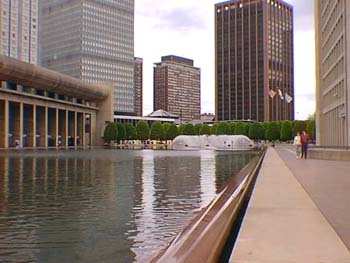
If Boston is the Hub of the Universe --if the universe is in fact a wheel -- then the skyscraper at the World Headquarters of the First Church of Christ Scientist is the air stem of the inner tube, where the religious pressures of the world are measured.

There are many secrets here, at the world headquarters-- things you'd enevr guess just by enjoying the reflecting pool and pefectly maintained grounds. Oh, you can visit the lobby, tour the cathedral, visit the map room where you can take a guided tour through a giant stained-glass model of the world, but no one will explain it all to you, what the globe is for, and if you ask even simple questions such as ‘Why was the 100-ton, eleven-foot granite pyramid that the Freemasons dedicated to church founder Mary Baker Eddy on her 100th birthday demolished?’ or ‘Is it true that the Church tried to assassinate Mark Twain for his highly critical, 1907 essays debunking Christian Science?’ or even ‘Is it true that Eddy was interred with a working telephone in her crypt, so that if (say ‘when’ instead of ‘if’ and maybe they’ll be nicer to you then they were to me) she rises from the dead, she can call to have her tomb unsealed?,' they’ll kick your ass out in a most unchristian manner.

The skyscraper, as I mentioned, is one big secret. If you could have been there when they were slapping that building together, you would have seen some strange shit going down as the concrete went up. For example: The girders are all cold-riveted, with match-grained metal being used in all of it, from the I-beams to the smallest bolt.

Most of the grain is aligned north, but a good deal of it struck out in line with the largest lay line in the city (the one that runs down from the church in Mission Hill through to the Prudential tower, down just outside of Sonsie, that fancy bistro on Newbury Street, which explains the bad karma at that place, why so many of the help there has gone batty, but that's a story for another time), which makes it a proper cross, and crosses have meant something long before that Nazarene carpenter was spiked up to one, that's something a good many 'modern pagans' lose sight of.

See, there's a good deal more going on at the World Headquarters of The First Church of Christ, Scientist, than just another twist Catholicism, just like there's a lot more behind the Mormons than Osmonds (There was a lot more to Donny playing Joseph in ‘The Amazing Technicolor Dreamcoat’ a few years back, as well, and that should be evident in the fact that Andrew Lloyd Webber is a dyed-in-the-wool Scientologist. The only reason it's not "L. Ron Hubbard, Superstar", is because of the money thing), and you can see this if you look around: there are ten pillars along the south face of the main building, one for each arm of Kali, and the weather vane up top of the old church is --if you ever get a close look at it, you'd recognize this -- an ancient Freemason symbol. This, then, is where the pyramid meets the eye.

You need a look at the Church from the above --find a nice satellite photo, or get yourself up into the Hancock tower (the Pru's view is too skewed, and this is the REAL reason why they closed the observation deck on the Hancock tower) and look at the lay of the place, to see the truth of the design. But what's most evident, even from the ground, is the tall building, the skyscraper, is supposed to look like a bible, but is doesn't, it looks like something else, namely an enormous erect phallus, and you'd be right to say that this is an odd thing to build a church to resemble, but this isn't only about church, it's about power, it's about science. Hence the name.

If you could get into the basement, in the secret underground bunkers hidden beneath the reflecting pool, if you could see these football-field sized rooms full of mainframes, ouija boards, and stacks and stacks of back issues on the Christian Science Monitor, you’d know there's more going on here than simple worship. This is Mary Baker Eddy's dream, down here, and you should see it, while it lasts, because the marriage of Christ and Scientists is a wave that's about to break.

It's money, that's breaking the back of this fine tradition: seems that there's not as much as there used to be in either Christ or science, so of late, the World Headquarters has been somewhat strapped for cash. This poverty is evident in everything.

In these hidden underground rooms, where you can feel the rumble of traffic as it whistles past on the Massachusetts Turnpike, right above your head, the 100-year history of Ms. Baker’s faith is coming to a close. The floor tiles are that ugly, light-blue supermarket linoleum, with some white ones thrown in, to mix it up a little. Half of the lights are out, in this vast subterranean space, due to cost considerations. The place is cool in summer, positively cold in winter: you can see your breath as you navigate through the empty desks and wheezing machines. Many of the computer systems down here are antiquated, with floppy drives, or even reel-to-reel systems. The monitors all glow with that sickening green shade that dates them as circa 1986, and a good deal of the technology that is here, doesn't work, at least, it isn't turned on. The help isn't what is used to be, either.

There's a job crunch on in Boston, but people are stubborn, and won't work for just anybody, for anything, anymore, so the days when the First Church of Christ, Scientist could pick and choose are gone. The people you see down here these days, in their torn jeans, flannel shirts and ball caps, are all from MIT, or Northeastern, or even Berkeley, and they are simply filling time, paying no more attention to the charting and monitoring of the world's religious tendencies than they would to delivering pizza or waiting tables.

One of them sits, with his feet up on the console, beneath the Big Board, which is a Mercado Projection of the world, and demonstrates what part of what population believes what today. The monitor is old, and large parts of the world have fallen into an apathetic shade of blue.
The punk who is supposed to be watching the monitor is using the telephone. He knows that if the red line beeps, it means that Mary Baker Eddy is calling on the phone that she was buried with, and he knows to pick up, if that happens.

He doesn't, however, know who Mary Baker Eddy is.

Tuesday, November 21, 2006

A Native’s Guide to Boston, Part 1: The Underground by G. Adams

I already have several blogs that discuss several topics, so when BBT invited me to contribute to their blog, I wasn't immediately certain about what I could bring that was new. But then it occurred to me that as BBT is published here in Boston - a town I know well-- but distributed all over, I might talk a little bit about the town I live in, to bring some of you who might not know this town very well a bit closer to the truth.

Boston's a great place, if you didn’t already know. It's a relatively small city --some call it a walking city-- but the even better news is that visitors don't have to walkwe have one of the oldest, yet most reliable, public transportation systems in America.

What I like msot to do, when I’m feeling adventurous and maybe a little off my head—you know, that mix of near-suicidal recklessness and despair that can grab you after another day has gone irretrievably sour and the faces of strangers stab at you like icepicks, where the cheap beer and the-god-knows-what you lifted from your roommate’s stash—it might have been powder, it might have been pills, it might have been smoke laced with anything from meth to drain cleaner to banana leaves—when all that settles in and it’s a lifetime between the beatings of your useless heart, that’s when you should do what I do when such a state take me, and walk the city underground, in the trolley tunnels, down there with the taggers and the homeless and the rats.
And the other things, but I’ll get to that.

You can get in by Northeastern University, over on Huntington Avenue. Just walk yourself down into the hole, there. You might think you’ll need a flashlight, but don’t bring one. Lights just cause problems.

Now, these trolley tunnels are old, they go way, way back, and the man who designed them died in them.

He was haunted by dreams of his tunnels, the way that they run beneath the city like hollow snakes, and one night, when he was sleepwalking through the underground in his cap and gown, with an old bullseye lantern, --this was 1884, remember -- whack, he met his end beneath the running metal wheels of the last car out of what was then Tremont Station.

True story, based on fact.

Part of the problem was that those old cars, they had shitty lights, and worse brakes, and another part of the problem was that these guys, the drivers, they were sort of drunk with the power of those early cars, and also, to be completely honest, they were frightened to be down there, as well.

The tunnels weren't the well lit, back then, as I have said, and when you're in an open car, chugging through the earth at thirty miles an hour, with just an oil lamp to see by, well, things get a little spooky, shit gets a little strange. Things would happen, and people would talk. You would get stories going 'round--

--like the car the went out of Park Station, at 3:15, so full of people that you could hear the rails creak beneath the weight, and that rolled into Government empty, picked clean as the stem you toss away after you have eaten all of the grapes.

--like about the stretch of track between South Station and Broadway, about by Fort Hill Channel, that is simply dead. You can't hear it too well, on the train, but if you ride the Red Line at all you have probably been through it, and maybe you thought that quick stutter of silence was your ears popping, but it's something else altogether. There simply is no sound in this spot, and the drivers know it and they run the cars through so quickly that the dead spot is no more than a ripple in the thrumming of the subway cars and the constant talk. You actually feel it more when you are asleep. It stays with you then, it clings. It’s difficult to keep a light burning in that place. In the old days, the gaslights would all gutter out. Even today, the electrics quiver, and the subway lights strobe until the car is through.

--and there's been talk among the conductors as long as there's been trains, about how they might see something that looks like a baby, or a toddler, a lost child on the tracks, and they might stop to get a closer look, but it was never children, though, or at least not your typical children, not like the kind that you'd usually see. After the few drivers who'd survived close looks at the things told their stories around, the rest knew better, and they all took to rolling their cars over anything that might wander into their way.

Especially anything that glowed.

This sort of thing happened so much on the Blue Line, so many little bundles of white dash out from the walls and onto the tracks, or they thump into the sides, or maybe they get hit, and you get this sound, like a melon being popped on the rails, that the drivers call the run between State and Aquarium the Nursery.

And one more: when they came down and found Mr. I-Designed-These-Tunnels dead in his bathrobe and slippers, sure, he'd been whacked by a three-car trolley, and sure, it was to expected that he would be in bad shape, but brother, bad don't even begin to get into the shape he was in.

Look at it this way: even if you get hit by a train--hard--even if that train sends you to bits, into gobbets-- there should be some accounting for those gobbets. There should be enough parts there, when you sling them all together, to make up one person, no more, no less.

Well, that wasn't the case, here. What they gathered together in a basket and brought up into the light, when they put it all together, so to speak, was about two-thirds our friend and neighbor, and some inestimable percentage of something else, something which had been knocked apart when the train hit it, something that got very cold when it was dead. Anything more about it-- what it was, where it came from, what it was doing down there, with our little urban transportation chief-- that was just guesswork.

You want a real treat, then someday, go down to Reservoir, or Riverside, or North Station, or any station where the lines end and the empty cars are stacked up like dead soldiers, and watch what they blast free from the underside of the trains with high pressure hoses.

It'll be worth your token, trust me on this one.

Wednesday, November 15, 2006

Our offices have moved...


Disclaimer: This blog is only marginally related to BBT Magazine, however, it does contain ghosts, lighthouses, ships captains, couples living on deserted islands, and Edgar Allen Poe.


In addition to being a big publishing magnate I am also a boat captain, a line of work which has opened many unusual doors for my wife and me in the past few years. After running and living in a slightly haunted lighthouse in San Francisco Bay on a tiny little island (which our dear friends now run, bless their little hearts), we packed up and moved to the Boston area, and we love it.


A few months ago I was hired as a ferry boat captain for the Thompson Island Outward Bound program, a program which has a mission statement we both heartily endorse, and shortly thereafter my wife was hired as a mate.


It’s nice really, having my mate as my Mate, and we really enjoy each others company.


We gradually learned the amazing history of the island in bits and pieces. Here’s a bit of it from the Boston Harbor Islands website:

“In 1626 (four years before the Puritans arrived in Boston) David Thompson established a trading post to trade with the Neponset Indians on the island that now bears his name… …For the next two centuries, Thompson Island was also leased to several different families for farming.”

In 1832 it was made a farm school for children who were destitute as a result of the War of 1812, and by 1834 it had acquired the rather creepy name of “The Boston Asylum for Indigent Boys” and later “The Boston Asylum and Farm School for Indigent Boys.” From that point forward it has continued to be a place where education of children has flourished.


Twice, in 1842 & 1892, the ferry boats full of boys, sank into the sea on the way to the island. The remains of all the lads are buried on the western side of the island, along with the remains of Native Americans the found on the island while they were building schoolrooms and dorms. There is a very old sign there which reads "Two tragedies of the Boston Harbor in 1842 & 1892 drowned these boys. May the water and the winds bless their souls; may their souls bless our hearts and our island."


All and all a fairly creepy, but also seemingly happy place, to judge by the old photos of the boys.

After a month or so the offer to care take the island while the program shut down for the winter was advanced to my wife and myself, and we accepted. We have had experience living on small islands before (very small – the lighthouse was on a rock ¾ of an acre), so we are aware of the romance & reality of the situation, but as a writer, and publisher of a small press magazine, I could hardly say no. We will have the whole place to ourselves (usually) and we should have time to pursue our various projects.

We’ll just have to ignore the tales of people waking up in the middle of the night to find little boys standing in their rooms by the bed, and the woman in green who shows up at the docks at night, presumably waiting for her son.

We’ll keep you posted…

Oh, and Edgar Allen Poe?
He was stationed across the water about a mile away from us at Castle Island and old army fort. It’s where he wrote "The Cask of Amontillado."

Yep. Lotsa history.